Antimicrobial Sensitivity Profiles of Bacteria Isolated from Gut of Chicken to Common Antibiotics and Chitosan-Encapsulated Neem Oil with Perspective to Risk Factors
Kiplimo M.
Department of Animal Sciences, School of Natural Resources and Animal Sciences, Jomo Kenyatta University of Agriculture and Technology (JKUAT), P.O. Box 62000-00200, Nairobi, Kenya.
Gichanga M. N.
Department of Animal Sciences, School of Natural Resources and Animal Sciences, Jomo Kenyatta University of Agriculture and Technology (JKUAT), P.O. Box 62000-00200, Nairobi, Kenya.
Muli M. M.
Department of Animal Sciences, School of Natural Resources and Animal Sciences, Jomo Kenyatta University of Agriculture and Technology (JKUAT), P.O. Box 62000-00200, Nairobi, Kenya.
Mawio D.M.
Department of Animal Sciences, School of Natural Resources and Animal Sciences, Jomo Kenyatta University of Agriculture and Technology (JKUAT), P.O. Box 62000-00200, Nairobi, Kenya.
Otieno S.O.
Department of Animal Sciences, School of Natural Resources and Animal Sciences, Jomo Kenyatta University of Agriculture and Technology (JKUAT), P.O. Box 62000-00200, Nairobi, Kenya.
Kagira J. M *
Department of Animal Sciences, School of Natural Resources and Animal Sciences, Jomo Kenyatta University of Agriculture and Technology (JKUAT), P.O. Box 62000-00200, Nairobi, Kenya.
*Author to whom correspondence should be addressed.
Abstract
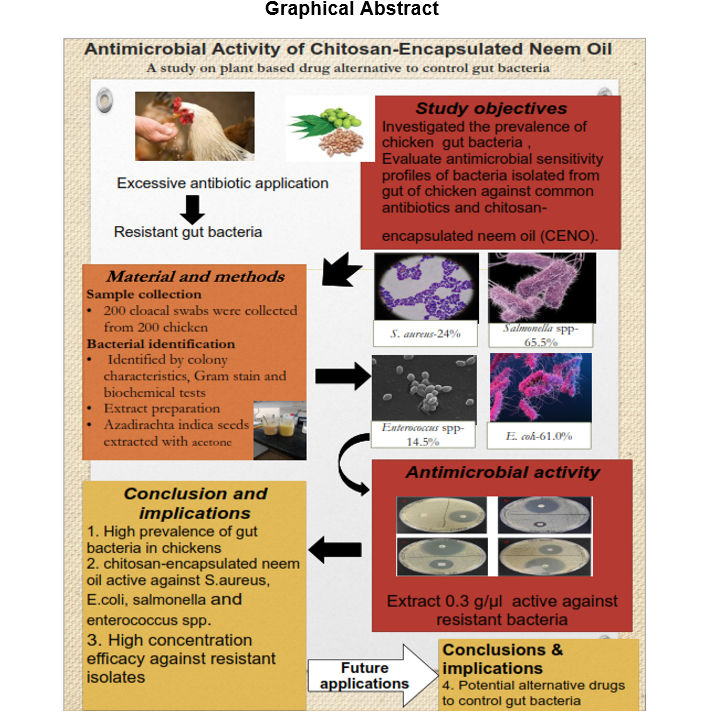
Globally, the indiscriminate use of antibiotics has increased antimicrobial resistance (AMR) and reduced stability of commensal microbiota in chicken gut. This has called for surveillance of the burden of AMR in chicken and development of alternative plant-based products such as neem (Azadirachta indica) oil as antimicrobial applications. This study investigated the prevalence, risk factors and antimicrobial sensitivity profiles of bacteria isolated from gut of chicken against common antibiotics and chitosan-encapsulated neem oil (CENO). The cross-sectional study was conducted in Thika East Sub-County, where 200 chicken from 40 farms were sampled. A total of 200 cloacal swabs of mature chickens were collected. Risk factors associated with prevalence of bacteria were assessed using structured questionnaires. The cloacal swabs were subjected to bacterial culture, isolation and identification while antimicrobial sensitivity testing was conducted using Kirby Bauer disc diffusion technique. The overall prevalence of bacterial infections in the chicken was 88.5% (177/200). Among the bacterial isolates, Salmonella spp. was the most prevalent (66.5%) bacteria, followed by Escherichia coli (61.0%), Staphylococcus aureus (24.0%) and Enterococcus spp. (14.5%). Chicken from farms which lacked foot bath had significantly (P<0.05) higher prevalence (92.0%) of bacteria compared to those from farms with a foot bath (87.3%). Additionally, chickens from farms that did not practice vaccinations had significantly (P<0.001) higher prevalence of gut bacteria (90.8%) compared to those which were vaccinated (87.4%). Escherichia coli and Salmonella spp. isolates were more resistant to penicillin (56.4%; 43.6%) and ciprofloxacin (43.6%; 30.8%) compared to other antibiotics. Further, S. aureus and Enterococcus spp. were more resistant to penicillin (50.0%; 50.0%) and tetracycline (46.7%; 53.8%). At 0.3 g/mL, laboratory extracted CENO exhibited antibacterial activity against S. aureus (30.8%), E. coli (33.3%), and Salmonella spp. (30.8%) and Enterococcus spp. (23.1%). Commercial CENO at the same concentration (0.3 g/mL) showed antibacterial activity against S. aureus (30%), E. coli (23.1%), Salmonella spp. (17.9%), and Enterococcus spp. (15.4%). In conclusion, this study demonstrated a high prevalence of bacteria in chickens from the study area, with Salmonella spp. and E. coli being the most prevalent. The observed antimicrobial activity of neem oil should be investigated further with an aim for coming up with alternative antibiotics for use in management of pathogenic gut infections in poultry.
Keywords: Encapsulated neem oil, risk factors, bacteria, antibiotics, Thika East, Kenya